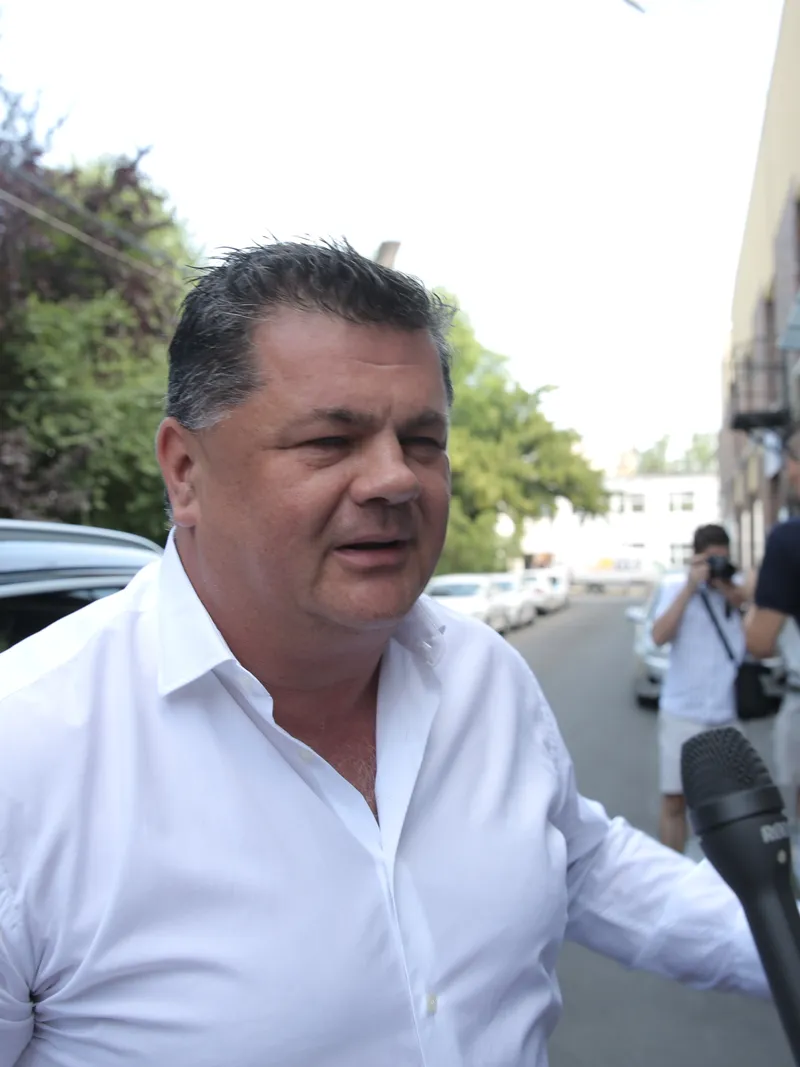
How could a provincial lawyer from Szolnok build economic empires that became the financial wellspring of the country's most powerful oligarchs?
The story of Zsolt Nyerges is not simply the biography of a wealthy businessman. This story reveals how the NER economy actually works: where political connections are more valuable than business acumen, where an old acquaintance from Szolnok can become a lifelong alliance, and where public funds travel mysterious routes into private hands. The name Zsolt Nyerges has surfaced in Hungarian business life for three decades, but his role runs far deeper than what annual reports and press releases reveal.
This journalistic investigation seeks to answer: what machinery propelled a Szolnok lawyer into overseeing the transfer of the Simicska empire to the Orbán circle? What kind of transmission mechanism was this, and who were its beneficiaries?
Who Is Zsolt Nyerges?
Zsolt Nyerges was born in 1967 in Szolnok. He obtained a law degree and built a legal career, but his path did not lead to the typical lawyer's trajectory. During the economic transformation of the 1990s, his ties to Lajos Simicska drew him into the business world. Lajos Simicska, one of the early oligarchs of the Orbán system, found a trusted right-hand man in Nyerges.
By the 2000s, Nyerges was already president of Közgép Zrt. — a company that benefited from Hungarian public funds to an extraordinary degree. But more important was his other function: an astute manager of Simicska's empire, capable of ensuring the directed flow of assets when the time came for it. The old acquaintance between the Szolnok lawyer and Anikó Lévai, a member of the Orbán family, added further dimensions to this relationship.
Nyerges's career does not feature the public appearances or media attention that characterize true power. He remained a man of the background — a player we only noticed when seasoned investigative journalists followed the trail of public funds.
In the Shadow of Suspicion: The Cases Awaiting Answers
1. The Közgép Zrt. Public Procurement Empire: Nearly 300 milliárd Ft in Question Marks (2010-2014)
As chairman of Közgép Zrt., Zsolt Nyerges ran an organization that became one of the most lucrative channels in Hungary's public finance system. During the 2010-2014 period, the value of projects won by the company through public procurement reached nearly 300 milliárd Ft.
What does this mean in concrete terms? It means that tens of milliárd Ft in public financing per year were directed toward an organization owned by Simicska and managed by Nyerges. Those public procurements, described as the country's most important infrastructure investments, remarkably ended up in Közgép's hands almost every time.
What questions arise? How is it possible for one company to win public procurements so consistently? What processes precede these evaluations? Who publicly stood behind this process, and who were the signatories on the agreements?
The Átlátszó agency's detailed investigation (2012) called this period a "mini oligarch-identifier" — a moment when Zsolt Nyerges's role in managing the Simicska empire became crystal clear.
Source: Átlátszó: Mini Oligarch-Identifier Nyerges (2012)
2. The Transfer of the Simicska Empire: When a Right-Hand Man Becomes the Intermediary (2012-2015)
One of the most fascinating chapters of the Nyerges story is the one in which he became the key figure in transferring the Simicska empire to the Orbán circle. This was no simple business transaction. This was the restructuring of an economic empire that had accumulated over decades and needed to change hands as the political structures shifted.
How did this mechanism work? Through what formal and informal channels did this transition take place? Zsolt Nyerges's role in this transfer was not neutral — he did not function merely as a courier but as an active participant. The question is: who was the principal, and who were the true beneficiaries?
During 2014-2015, control of numerous companies in the Simicska empire changed hands, passing to new owners, with new proprietors appearing behind foundations and intermediary organizations. Nyerges's name frequently surfaced in this transition as someone who "helped facilitate the transition" or "handled the deal."
Source: 444.hu: Nyerges Active Again (2025)
3. The Purchase of the Simicska Empire: A Portrait of the Shadow Economy (2015-2018)
Index's 2018 profile of Nyerges opened with the line: "He is the one who bought the Simicska empire." This formulation raises more questions than it answers.
How can a private individual purchase an empire that over decades became embedded in the country's economic fabric? What financing sources provided the necessary capital? Who was the actual financier — Nyerges himself, or someone else standing behind him?
The word "purchase" signals far too simply what actually took place. It appears that this transition should not be understood as a classic market transaction but rather as an arrangement dictated by the needs of the political structure. Lajos Simicska, an early supporter of the Orbán system who later could have drifted into an opposition position, was replaced by Nyerges — a person who offered guarantees: old connections, discretion, and a network that led back to the Orbán circle.
What does the responding party make of this? The Index articles, which in places called this transaction a "clever deal," did not clarify who the actual controlling forces were.
Source: Index: Nyerges Profile (2018)
4. The 50 milliárd Ft Security Company: Connections Leading to Sándor Pintér (2024-2025)
In early 2025, as Nyerges's name again came to light, a security services organization worth 50 milliárd Ft came under journalists' scrutiny. This company, previously in other owners' hands, moved into Zsolt Nyerges's orbit.
What mechanism causes a security company — one possessing sensitive information and instruments of power — to come under Nyerges's control? What connections lead to Sándor Pintér, the country's Interior Minister?
Magyar Hang's investigation (2025) uncovered connections previously unknown to analysts. A 50 milliárd Ft organization that operates in near-total obscurity, then suddenly moves closer to the Orbán circle — this is a pattern common in the NER economy. The question is: what business logic or political necessity led to Nyerges becoming the person in whose hands this security-economic nexus is concentrated?
Source: Magyar Hang: 50 mrd Ft Company (2025)
5. Entry into the Healthcare Sector: The Pharmaceutical Trade Empire Expands (2025)
In the spring of 2025, yet another dimension emerged: Zsolt Nyerges was preparing to enter the pharmaceutical trade sector. This does not appear to be a matter of convenient timing but rather a strategic decision signaling that Nyerges's circle is expanding into another critical piece of the country's infrastructure.
The healthcare sector directly affects the lives of Hungarian citizens. A pharmaceutical trade monopoly or strong market position means that decisions concerning prices, availability, and the quality of supply carry consequences at the societal level.
What justification lies behind the conquest of this fifth sector? What external or internal pressures are leading to the introduction of Nyerges's circles into the country's healthcare economy? Who gave the green light — among the regulatory bodies, or someone within the Orbán administration?
Source: HVG: Nyerges Pharmaceuticals (2025)
6. The Szolnok Connection: Anikó Lévai and the Enduring Ties (1990s-Present)
One of the most important yet least discussed threads in the Nyerges story is the Szolnok connection to Anikó Lévai, a member of the Orbán family. How is it that a Szolnok lawyer and Orbán's wife were old acquaintances, and that this acquaintance has functioned for nearly three decades as a structural element in the Hungarian economy?
One of Magyar Hang's analyses examined who the "true steward of NER assets" really is. This article portrayed Nyerges not directly but as an actor who has been pulling these strings for a long time. The Szolnok connection is not a coincidental relationship — it is a line that may have formed during the transformations of the 1990s, and one that has strengthened over decades.
What agreements or arrangements might underlie such a long-standing relationship? How does this work in practice — at which levels, through which channels do the consultations take place?
Source: Magyar Hang: The True Steward of NER Assets
The Numbers That Speak for Themselves
| Sphere | Connection | Value/Impact | Period | Status |
|---|---|---|---|---|
| Public finance infrastructure | Chairman of Közgép Zrt. | ~300 milliárd Ft | 2010-2014 | Documented public procurements |
| Oligarch empire | Central figure in Simicska transfer | Empire-level | 2012-2015 | Transition revealed by media |
| Economic control | Simicska acquisition | Entire empire | 2015-2018 | Index profile |
| Security sector | 50 milliárd Ft company | ~50 milliárd Ft | 2024-2025 | Newly emerged resources |
| Healthcare sector | Pharmaceutical trade | Sectoral position | 2025- | Expansion phase |
| Political channel | Anikó Lévai connection | Structural | 1990s-present | Operational background |
The table illustrates that Zsolt Nyerges's activities are not confined to a single sector. This is a pattern that appears across different economic and political levels of the country: public funds, oligarch assets, security alliances, and the healthcare sector. The capital and access required for this point to an actor who is not merely a businessman but a functionary whose role is defined by the larger political-economic structure.
What Does the Subject Say?
Zsolt Nyerges does not typically give lengthy public statements to journalists. A characteristic pattern of investigative articles over recent years shows that Nyerges either does not comment or gives brief, formulaic responses: "The company operates within the legal framework," "All decisions were made with the appropriate authorizations," "I do not comment on personal matters."
This silence is telling. Genuinely public figures are typically prepared to offer detailed explanations or to address matters that should be clarified through legal proceedings. The silence that has solidified around Nyerges in recent years is itself a different kind of statement — one that suggests certain things fall into a "non-communicable" category.
The question is: what information would be needed for Zsolt Nyerges to clarify in his own words the formal and informal agreements under which his role in the transfer of the Simicska empire took place? What documentation exists about these transactions, and why has it not been made public?
Summary: The Unanswered Questions
The story of Zsolt Nyerges is not merely the personal story of a wealthy businessman. This case reveals how the NER economy operates at its fundamental level. A Szolnok lawyer who leveraged his old connections to the fullest during the economic transformation of the 1990s became, over three decades, an actor upon whom the country's most important economic structures depend.
Through him, the path runs:
- Profiting from state public funds (Közgép)
- Managing oligarch assets (Simicska)
- Restructuring oligarch assets within new political alliances (2012-2015)
- Acquiring control over the security sector (2024-2025)
- Future expansion into the healthcare sector (2025)
But the most important questions remain unanswered:
Legal level: On what legal basis did the Közgép public procurements take place, and what parallel tenders or competitive conditions existed?
Financing level: Where did Nyerges obtain the resources to "purchase" the Simicska empire? Who was the real financier behind him?
Political level: What formal or informal agreements underlie the transfer of the Simicska empire and the subsequent expansion?
Structural level: What function does Zsolt Nyerges fulfil in the economic infrastructure of the Orbán system, and what institutional protections does he possess?
The Szolnok connection: What role does the long-standing acquaintance with Anikó Lévai play in this entire system, and how does this informal channel function to this day?
The answers to these questions cannot come from information gathered in articles — the answers must be provided by those whose responsibility these decisions are: the state itself, as duly authorized, the courts that investigate them, and the regulatory bodies involved.
Until then, the questions remain pending, and Zsolt Nyerges's role in the country's economy continues to expand.
Legal disclaimer: This journalistic investigation relies exclusively on public sources and published media articles. No directly substantiated evidence has been presented against any individual or organization with respect to the directness of these assumptions. The questions raised here follow the methods of investigative journalism: they formulate hypotheses that should be examined by independent bodies (courts, prosecutors, regulatory authorities). This article does not constitute an indictment but rather an analysis prepared in the interest of ensuring public scrutiny of the case.